-
Blake.Chu sales consultant
-
Email: 113217160@qq.com
-
Phone/WeChat +86 19129108136
What is The Thinnest Diamond Saw Blade
I. Introduction
In the processing of stone and granite, there are many pain points in the traditional thick diamond saw blade. When the cutter body is thick, the cutting resistance is high, and edge chipping and cracking easily occur when processing brittle stone. The material loss is high, the cutting accuracy is poor, the incision is rough, so extra polishing treatment is often needed, which not only wastes raw materials, but also reduces the processing efficiency and affects the appearance of finished products.
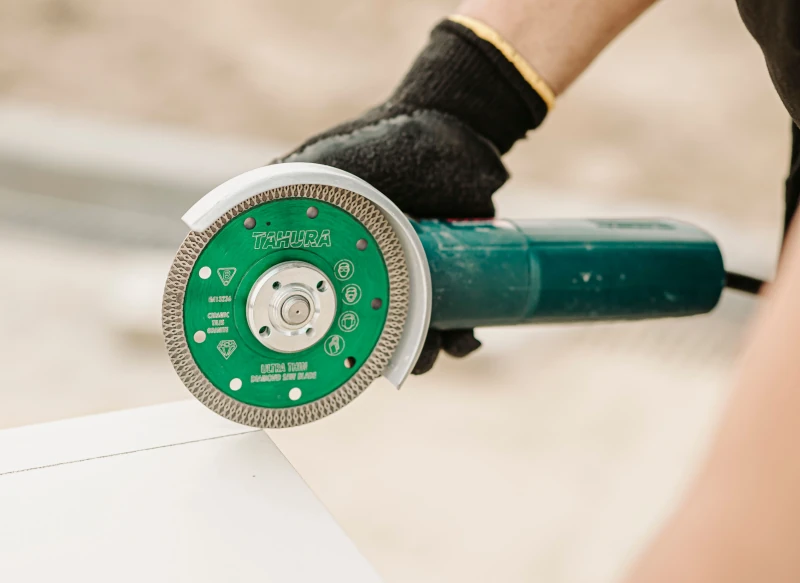
The thinnest diamond saw blade is specially developed for fine cutting of stone and granite. Its cutting edge is thinner, the cutting gap is small, the material loss is effectively reduced, the edge chipping phenomenon is reduced, the incision is flat, the machining accuracy is higher, and it is suitable for high‑precision thin cutting operation.
This paper will introduce the ultimate thickness, product characteristics, specifications, usage, application scenarios and procurement points of ultra‑thin diamond saw blades, and answer common FAQs in the industry to help users do a good job in selection and practice.
II. The thinnest diamond saw blade core
2.1 What is the thinnest diamond saw blade?
Ultra‑thin diamond saw blade is a subdivision tool for thinning the thickness of matrix and diamond segments, focusing on narrowing the slit width and reducing the specific energy consumption of sawing, and facing the fine cutting of brittle hard materials. The common saw blade has wide slit and high rough cutting efficiency, but the sawing impact load is large, and edge chipping is easy to occur in granite processing. The special stone model optimizes the diamond concentration, particle size mesh and matrix formula, improves the radial stiffness of the matrix, reduces the sawing resistance, ensures the smoothness of the cut, and adapts to trimming and high‑precision blanking conditions.
2.2 How thin can the thinnest diamond saw blade be?
The thickness range of conventional diamond segment of ultra‑thin saw blade in stone industry is 1.2‑1.6 mm. The industrial limit thinness can reach 0.7‑0.8 mm, which is mostly used for precision cutting of precious stones, and the requirements for spindle radial runout control of equipment are strict. Thinning the saw blade can reduce the kerf width and improve the machining accuracy, but the radial stiffness of the matrix decreases, which is easy to produce deflection and directly reduces the service life of the saw blade. When processing granite, both deformation resistance and notch quality should be taken into account, and the optimal segment thickness for comprehensive selection is recommended to be 1.4‑1.6 mm.
2.3 Special Introduction of Grinding Ultra‑thin Diamond Cutting Piece
The core differences between them are embodied in the segment configuration, matrix binder formula and material removal mechanism. Ordinary cutting saw blades rely on cutting edges to realize radial cutting; The grinding type relies on the end face and side edge to remove materials by abrasion.
Working principle: During high‑speed rotation, the diamond abrasive particles peel off the material through sliding and ploughing effect, and the matrix binder is controlled to wear, and new abrasive particles are continuously produced to maintain stable grinding ability.
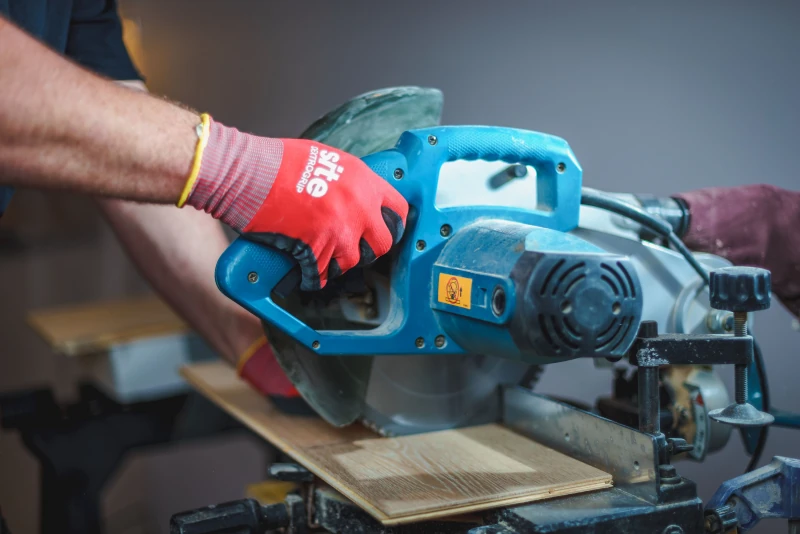
When it is used in granite processing, it can finish fine trimming, chamfering and thin cutting operations, with low cutting load, effectively restrain edge chipping, ensure the contour accuracy of the workpiece and reduce the margin of subsequent polishing procedures.
III. The product core advantages and specifications
3.1 Product Features
Relying on the optimized matrix binder formula and diamond abrasive ratio, the saw blade has many technical advantages compared with the traditional thick matrix saw blade. Narrowing the slit width and controlling the radial runout of the saw blade can improve the cutting accuracy and effectively restrain the edge chipping.
High‑grade abrasive particles improve the wear resistance of matrix, reduce the specific energy consumption and stone loss rate, and are suitable for brittle hard substrates such as granite, marble and artificial stone. The design of matrix stiffness and stress relief groove delays the abnormal wear of segments, prolongs the service life, inhibits the vibration under high‑speed rotation, and improves the operation safety. The comprehensive fine cutting performance is better than that of conventional sawing blades.
3.2 Technical parameters/product specification parameters
The following is a list of standard parameters of mainstream models of ultra‑thin diamond saw blades for stone and granite, covering common external diameter specifications for selection reference:
| Parameter Item | Unit | Spec 1 | Spec 2 | Spec 3 | Spec 4 | Spec 5 |
|---|---|---|---|---|---|---|
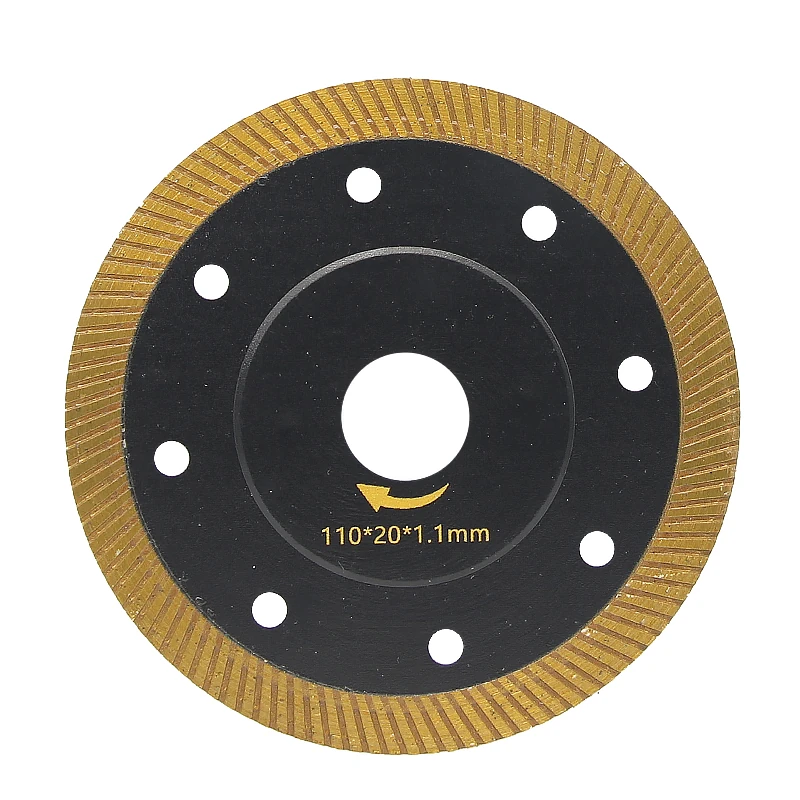
| Outer Diameter | mm | 110 | 115 | 125 | 150 | 180 |
| Inner Diameter (Bore) | mm | 20 | 20 / 22.23 | 22.23 | 22.23 | 22.23 / 25.4 |
| Segment Thickness | mm | 1.2‑1.4 | 1.2‑1.4 | 1.4‑1.6 | 1.4‑1.6 | 1.6‑1.8 |
| Steel Core Thickness | mm | 0.8‑1.0 | 0.8‑1.0 | 1.0‑1.2 | 1.0‑1.2 | 1.2‑1.4 |
| Segment Height | mm | 8‑10 | 8‑10 | 10‑12 | 10‑12 | 10‑14 |
| Diamond Grain Size | mesh | 60/70 | 60/70 | 50/60 | 45/50 | 40/45 |
| Recommended Rotation Speed | rpm | 13000‑15000 | 12500‑14500 | 11500‑13500 | 9500‑11500 | 8000‑9500 |
| Max. Cutting Depth | mm | 30‑34 | 32‑37 | 38‑42 | 46‑52 | 56‑64 |
| Compatible Machine | — | Angle Grinder (4″) | Angle Grinder (4.5″) | Angle Grinder (5″) | Marble Cutter / Table Saw | Table Saw / Hand‑held Cutter |
| Kerf Width | mm | 1.3‑1.5 | 1.3‑1.5 | 1.5‑1.7 | 1.5‑1.7 | 1.7‑1.9 |
Description of selection:
‑110–125 mm model is suitable for angle grinder for thin cutting, trimming and grooving stone and granite, which is portable and flexible.
‑150‑180 mm model is suitable for marble machine and bench cutting machine, which is used for plate cutting and countertop processing, with deeper cutting depth and suitable for batch fine cutting;
‑The larger the diamond particle size (the higher the mesh number), the finer the notch, which is suitable for finishing;
-The smaller the mesh number, the higher the grinding efficiency, which is suitable for fast blanking.
When selecting the type, it is necessary to check the spindle speed matching and the hole diameter consistent with the equipment flange to avoid matrix deformation or segment loss caused by the use of overspeed.

IV. Practical use and scene adaptation
4.1 Professional use guide
- Installation adaptation and debugging methods Before installation, check whether the saw blade matrix has cracks and segment defects, and confirm that the inner diameter of the saw blade matches the spindle and flange of the equipment. Flange end face should be kept flat and free from corrosion, and the locking torque should be moderate to avoid matrix deformation caused by overpressure. After the installation is completed, the idling test shall be carried out to detect the radial runout of the spindle. If there is obvious deflection, it is forbidden to put it into processing.
- Control standard of cutting speed and feed speed Strictly follow the maximum allowable speed of saw blade calibration, and overspeed operation is strictly prohibited. The rigidity of ultra‑thin saw blade is weak, so the feed speed should not be too fast; Granite processing adopts low‑speed creep, and material removal is completed by diamond abrasive particles. It is forbidden to push hard to prevent matrix distortion and segment loss.
- Matters needing attention in cutting stone and granite Priority is given to wet cutting process to reduce sawing heat load; Dry cutting requires intermittent operation to reduce thermal fatigue. Cutting granite brittle base material, avoid prying the workpiece sideways, preventing edge chipping, and forbidding to forcibly cut curves.
- Daily maintenance, cleaning and storage skills After processing, clean up the stone dust residue on the surface of the matrix and the block, and remove the sintering debris. Keep it dry and away from light, and place it in isolation, so as to prevent the matrix from being squeezed and deformed under pressure and away from corrosive media.
- Vulnerable problem avoidance and fault handling Incision deviation and increased vibration occur, mostly due to flange wear, excessive spindle runout or deformation of saw blade matrix, so stop the machine for investigation. The local passivation of the segment can be carried out by dressing treatment; When the matrix is cracked and the segment falls off in a large area, it must be scrapped directly and cannot be used any more.
4.2 Application scenarios
With the technological characteristics of narrow slit, low sawing loss and suppression of edge chipping, the saw blade is suitable for many kinds of high‑precision cutting conditions.
- Core scenes: granite plate finish cutting, natural stone finish machining, stone trimming and grooving, reducing the notch defect of brittle substrate, reducing the post‑polishing allowance, and meeting the requirements of plate shaping and precision notch machining.
- Subdivision scene: fine cutting of jewelry and jade, molding of small stone crafts, and blanking of thin stone to realize low‑damage processing and ensure the dimensional accuracy of workpiece outline.
- Universal scene: accurate cutting of hard stone materials and nonmetallic brittle substrates such as marble, quartz stone and artificial stone, compatible with dry/wet sawing process, suitable for angle grinder and small desktop cutting equipment.
V. Important Tips for Purchasing Pit Avoidance
The type selection should match the base material and working conditions, and the thickness of 1.4‑1.6 mm segment is preferred for processing granite. Industrial‑grade saw blade adopts high‑concentration diamond and high‑strength matrix binder, which is suitable for high‑frequency fine cutting; Civil grade is only suitable for short‑time light processing. Purchase and check the aperture, segment thickness and rated speed to ensure matching with the spindle flange. Low‑priced products have uneven abrasive particles and insufficient matrix strength, which are prone to edge chipping and matrix fracture, large loss and short life. The selection of high cost performance gives priority to the stability of matrix and the uniformity of abrasive particle arrangement.
VI. FAQ
Q1: What is the thinnest jewelry saw blade?
The special saw blade for jewelry can reach 0.4‑0.6 mm, which is different from the matrix bond and diamond particle size of stone saw blade. The stone saw blade has higher rigidity and is not suitable for micro‑precision cutting of gems.
Q2: Can a diamond blade cut thin metal?
Ultra‑thin stone saw blades are only suitable for brittle nonmetallic substrates. Cutting metal will cause abrasive particles to fall off prematurely, aggravate the loss of matrix, shorten the service life and pose safety risks.
Q3: What’s the name of the thin‑edged saw?
The professional name is ultra‑thin diamond cutting blade, commonly known as thin‑edged saw blade, and the subdivision includes grinding ultra‑thin diamond cutting blade.
Q4: How thick is the thin cutting saw blade?
Jewelry grade 0.4‑0.8mm; The thickness of stone industry segment is 1.2‑1.6mm, and granite is preferably 1.4‑1.6 mm.
VII. Summary
The thinnest diamond saw blade has outstanding core value in the field of granite and natural stone finishing because of its narrow slit width and controllable edge chipping suppression ability. By optimizing the ratio of matrix binder and diamond abrasive particles, the sawing loss of stone raw materials is reduced while ensuring the machining accuracy, and it is suitable for various technological conditions such as trimming, grooving and thin material cutting.
The selection should not blindly pursue the ultimate thinness, but should be comprehensively matched with the hardness of the processed substrate, radial runout of the spindle of the equipment, rated speed and other parameters. Only by standardizing the installation and debugging, following the operation specifications and doing a good job of maintenance can the service performance of the saw blade be fully exerted, taking into account the processing quality and operation safety, and achieving cost reduction and efficiency improvement for the stone fine cutting project。